The House of Cards Behind the GLP-1 Compounding Rush


The House of Cards Behind the GLP-1 Compounding Rush

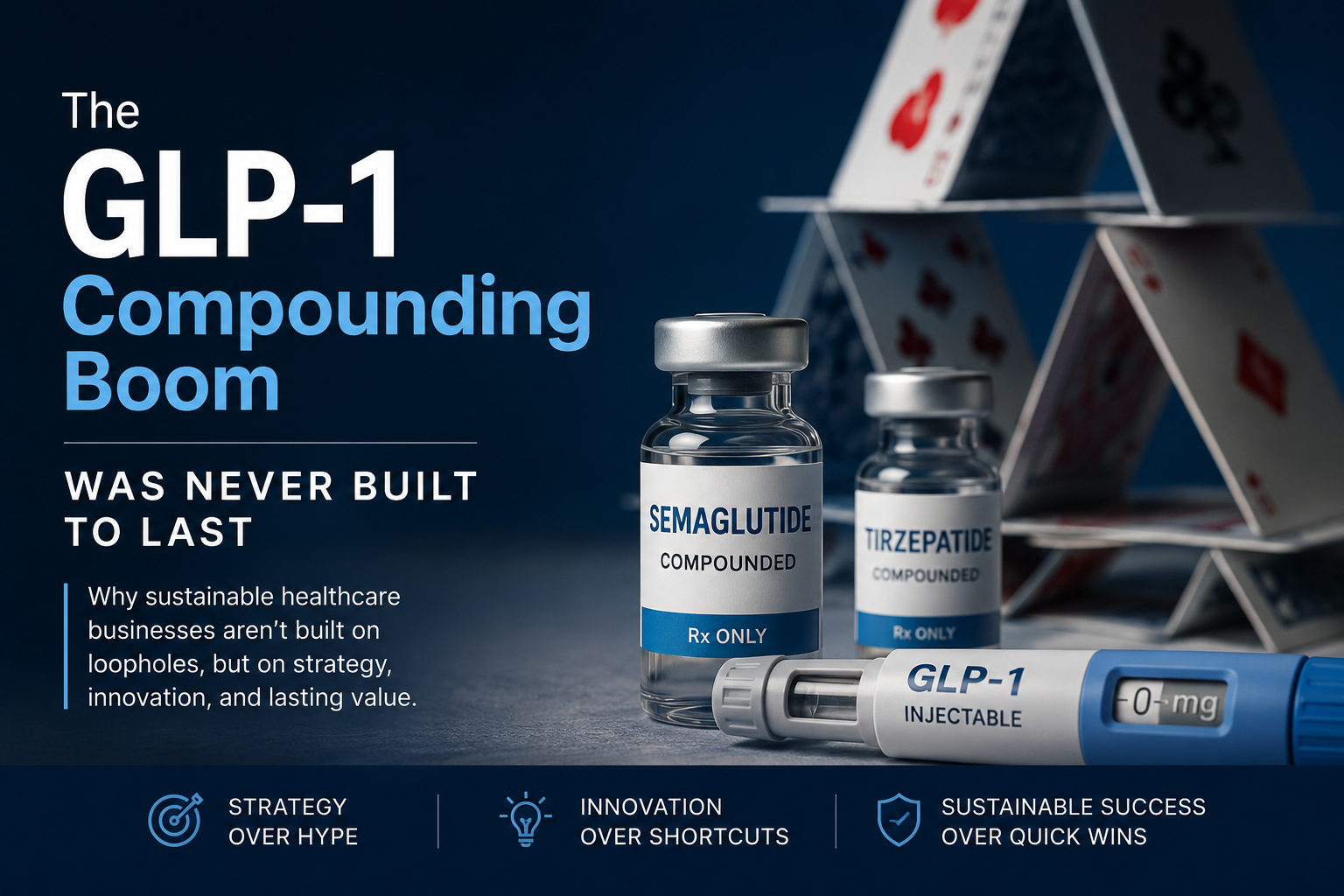
This may sound controversial to some, but we have been sounding the alarm on this for quite some time.
We consistently pushed back against the simplistic narrative that GLP-1 compounding was somehow going to become a permanently sustainable long-term business model.
During the height of the shortages, many investors, private equity groups, and operators viewed compounded GLP-1s as an easy P&L enhancer amid unprecedented demand. The economics were attractive, patient demand was real, and an entire ecosystem rapidly formed around the opportunity.
But if you are actually a pharmacist, as I am, you understand the original purpose and intent behind compounding pharmacies.
Compounding was never designed to function as a parallel commercial manufacturing channel for mass-market FDA-approved medications that are otherwise commercially available. The foundation of compounding has always been individualized patient care: customized therapies, non-commercially available formulations, allergy accommodations, dosage modifications, orphan conditions, and other clinical scenarios where traditional manufacturing does not adequately meet patient needs.
Over time, many operators attempted to create differentiation through additive combinations involving vitamin B12 or other ingredients, arguing that these represented unique formulations outside of commercially available products. But to many pharmacists, operators, and regulatory professionals, it was fairly apparent that this was unlikely to represent a durable long-term regulatory framework.
The FDA’s recent actions reinforce what many within the industry already understood: once shortages normalize and commercially available products return to market, the legal and regulatory foundation supporting large-scale compounded versions becomes significantly more difficult to defend.
To be clear, this does not mean traditional compounding disappears. Legitimate 503A compounding continues to serve an important role within healthcare. But there is a meaningful distinction between individualized patient-specific compounding and building large-scale commercial businesses around compounded versions of blockbuster FDA-approved drugs.
At its peak, an entire business ecosystem developed around what was ultimately a temporary market dislocation driven by shortages, extraordinary demand, and evolving regulatory interpretation. The opportunity was real, but so were the long-term sustainability questions.
Nothing here is fully finalized. Given the FDA process, litigation risk, and the number of stakeholders involved, this will likely continue evolving through both regulatory and legal channels over time.
But stepping back from the headlines, I think there is a broader lesson here.
Businesses built primarily around regulatory gray areas, temporary loopholes, or short-term market inefficiencies rarely create durable enterprise value over the long run. Sustainable healthcare businesses are typically built through operational excellence, differentiated services, infrastructure, innovation, and long-term strategic positioning.
That applies whether you are building a pharmacy platform, developing a healthcare services company, or creating the next iPhone.
At Workshop Strategy, this is exactly why we focus on sustainability over hype. We are far less interested in chasing temporary market highs and far more focused on helping businesses build models that can endure operationally, regulatorily, and financially for years to come.
"There is no rulebook. There’s only experience"
Sam Maddula, Pharm D.
CEO & Founder, Workshop Strategy

